In agricultural processing, the stakes are undeniably high. Leaving impurities like stones, glass, or chaff in your product often leads to catastrophic equipment damage downstream. You risk severe roller mill destruction. You face rejected batches. You severely compromise brand trust when foreign materials reach the end consumer. A common misconception plagues many facility managers. They assume a single piece of equipment handles all foreign material. However, relying on just one screening unit leaves you completely vulnerable to specific, hidden threats.
The core operational difference lies between size-based separation and weight-based separation. Understanding this physical distinction sets up a reliable framework. It helps you evaluate capital expenditures for your facility accurately. You will learn exactly how these two systems function. You will discover why distinguishing between them matters for your throughput. We will explore their specific mechanical roles. This guides you to protect your product purity effectively.
Key Takeaways
- Different Separation Principles: Grain cleaners sort by size and aerodynamics (using screens and aspiration), while destoners sort by specific gravity (weight/density).
- Sequential Operation: A destoner machine is rarely a standalone solution; it operates optimally after a grain cleaner has removed over/undersized debris.
- Impurity Profiles Dictate Need: If your harvest contains soil clods, pebbles, or glass identical in size to your good product, a gravity destoner is mandatory.
- Line Integration is Key: Matching throughput capacities and airflow (CFM) between machines is critical to avoid bottlenecks in a complete grain cleaning line.
Fundamental Differences in Separation Logic
Grain cleaners and destoners operate on entirely different physical principles. You cannot swap one for the other. Understanding the physics prevents costly facility errors. We must break down the size versus density paradigm clearly.
Grain cleaners rely purely on dimensional differences. They target the width and thickness of incoming materials. They also utilize aerodynamic drag. Stacked screens block larger items. Smaller debris falls through the mesh. An air channel pulls away light particles. The process ignores the actual weight of identically sized items. If a rock matches a soybean's dimensions, the screen lets it pass.
Conversely, destoners rely on specific gravity. They utilize fluidization. An upward air current pushes through a vibrating wire mesh deck. This air suspends lighter materials. It creates a fluidized bed of product. The lighter grain floats downward toward the discharge. Meanwhile, heavier items sink to the mesh. The deck's vibration pushes these heavy items upward. They walk up the slope against the product flow.
Why does this distinction matter for your capital expenditure? Investing in the wrong mechanism yields zero return. This happens if the targeted impurity shares the same physical characteristics as the good grain. A standard screen cannot catch a pebble shaped exactly like your target crop. You must match the machine's internal physics to your specific impurity traits. Otherwise, you waste valuable resources on ineffective sorting.
The Role of a Grain Cleaner (Capabilities and Limitations)
A primary screener acts as your facility's first line of defense. Think of it as the heavy-duty gatekeeper. A well-calibrated seed cleaning machine handles the bulk of raw field trash. It prepares the crop for precision downstream sorting.
This equipment successfully strips away large-volume impurities. It targets chaff, field dust, and weed seeds. It easily removes oversized stems. It catches shriveled or immature kernels. The machine tackles anything significantly larger or smaller than your prime product. It handles high capacities efficiently.
The mechanical components work in tandem. The machine uses multiple vibratory screen decks. These decks perform two distinct actions: scalping and sifting. Scalping uses large holes to remove oversized items like stalks. Sifting uses small holes to drop out undersized fines like sand. It combines these vibrating screens with air aspiration channels. The airflow aggressively pulls away light dust and loose husks before they reach the screens.
However, the machine has a fundamental limitation. It fails to remove impurities sharing the exact size and shape as the target grain. For instance, consider a small mud ball in a batch of coffee beans. If it matches the bean's dimensions, it easily passes through the scalping screen. It fails to fall through the sifting screen. It simply follows the good product right out the discharge chute. Size-based sorting is completely blind to density.
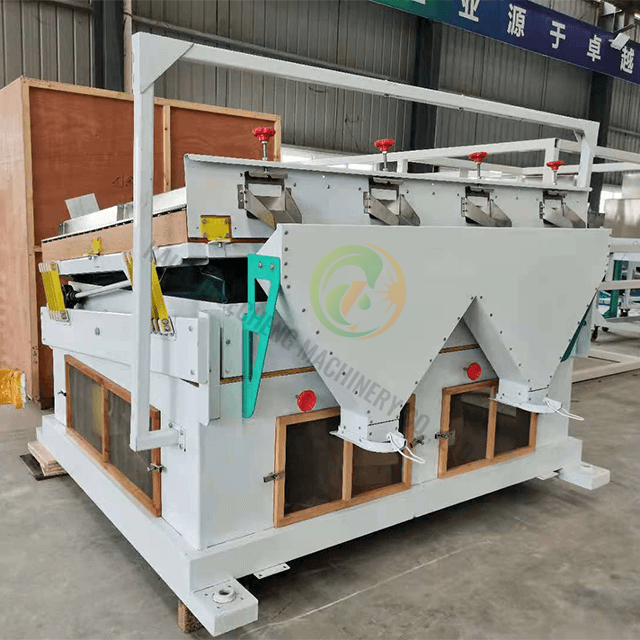
The Role of a Destoner Machine
Targeted removal of high-density foreign materials is essential for food safety. This is exactly where a dedicated destoner machine excels. It identifies density rather than geometry. It protects your brand from severe liability issues.
What does it remove successfully? It isolates heavy stones and broken glass. It catches dense mud balls. It frequently removes metallic fragments missed by upstream magnets. Commonly called a stone removal machine, this unit guarantees that heavy foreign objects exit the processing stream safely.
Operating a grain destoner requires strict operational parameters. It demands a highly specific feed rate. Consistent airflow is equally critical. These factors maintain the necessary fluidized bed. If the air drops, the grain stops floating. If the air spikes, stones blow over into the clean product. Operators must adjust the fan baffles meticulously for different crop weights.
We must emphasize a major implementation risk. Never feed uncleaned, trash-heavy grain directly into this unit. Doing so severely disrupts the fluidization. Chaff and large stalks block the air deck mesh. The air cannot distribute evenly. This leads to poor separation. You experience significant product loss. Good kernels will spill out alongside the stones. Always pre-clean your raw material first.
Decision Framework: Do You Need One, or Both?
Facility managers often struggle to justify adding more equipment. You need a clear framework to evaluate your exact requirements. We will look at two common processing scenarios.
Scenario A: Grain Cleaner Only
This setup relies exclusively on size separation. It is best for pre-cleaning incoming raw material before silo storage. It suits highly mechanized harvests experiencing zero ground contact. It works well if your final product undergoes further rigorous processing elsewhere. If you only need to remove stalks and light dust, size separation suffices.
Scenario B: Adding a Gravity Destoner
This setup introduces density separation. It is best for ground-harvested crops. Think of soybeans, lentils, peanuts, and coffee. It is absolutely mandatory for food-grade processing. You must protect expensive downstream milling equipment. A high-capacity gravity destoner saves roller mills from catastrophic stone damage. One rock can destroy a corrugated roll.
You must carefully review ROI calculation variables. Compare the equipment cost against your facility's historical losses. Calculate the price of rejected customer shipments. Factor in the hourly cost of manual sorting labor. Include replacement parts for damaged milling equipment. You will quickly see how raw material impurities dictate your equipment needs.
| Impurity Type | Separation Principle | Recommended Machine | Risk of Non-Removal |
| Oversized stalks, leaves, stems | Size (Width/Thickness) | Grain Cleaner | Silo blockages, poor aeration |
| Light dust, chaff, loose husks | Aerodynamics (Air Drag) | Grain Cleaner (Aspiration) | Combustible dust hazard |
| Identically sized stones, glass | Specific Gravity (Density) | Destoner | Mill damage, brand liability |
| Heavy mud balls, metallic fragments | Specific Gravity (Density) | Destoner | Contamination, food safety failure |
Implementation Realities for Your Grain Cleaning Line
Purchasing the right machine is only the first step. You must integrate it properly. Designing an efficient grain cleaning line requires careful planning. We need to look at sequence, capacity, and infrastructure.
Proper sequencing prevents equipment failure. You must organize machines logically. A successful facility layout follows a strict material flow. You cannot feed dirty grain into sensitive final sorters.
- Intake and Initial Buffering: Material enters the surge bin to stabilize the feed rate.
- Aspiration: Air channels remove lightweight dust and field chaff immediately.
- Screener: The unit removes oversized stalks and undersized fines.
- Destoner: The clean, sized product enters the fluidized bed for density sorting.
- Final Polish: An optical sorter or gravity separator performs final quality control.
Capacity matching is crucial. We warn strongly against bottlenecking your system. If the primary cleaner processes five tons per hour, downstream units must match it. The density separator must comfortably handle that exact output. If it only handles three tons, material backs up. You will face constant feed interruptions. Always match the cubic feet per minute (CFM) and tonnage ratings across the line.
Dust collection and environmental control demand attention. Both machines require robust aspiration. You need external cyclone dust collectors. They function safely only under negative pressure. This ensures compliance with stringent combustible dust regulations. Airborne agricultural dust poses severe explosion risks. Do not vent these machines directly into your processing room.
Floor space and facility footprint present physical challenges. Consider the reality of adding heavy equipment. You need adequate horizontal floor space. Multi-story gravity flows require heavy structural support. You must also account for vibration isolation. Dynamic vibrating decks transfer severe stress to the surrounding concrete. We recommend independent steel support frames to isolate the shaking.
Conclusion
Facility managers face complex choices, but evaluating these machines is rarely a true "versus" scenario. Grain cleaners handle raw volume and physical size efficiently. Meanwhile, destoners manage high density and strict precision. They complement each other perfectly in a modern processing environment. Relying on just one leaves your product vulnerable to specific contamination risks. Combining them ensures total quality control.
Before you request equipment quotes, you must gather data. Conduct a sieve and impurity analysis on your raw material. Take a ten-kilogram sample from your typical harvest. Sift it manually. Categorize the trash by size and weight. Definitively identify your unique impurity profile. Let these concrete physical traits dictate your engineering decisions.
FAQ
Q: Can a standard seed cleaning machine remove stones?
A: Only if the stones are significantly larger or smaller than the seed. If they are the exact same size, the screens will fail to separate them. The machine relies purely on dimensional differences, making it completely blind to the actual weight of identically sized impurities.
Q: How much maintenance does a gravity destoner require?
A: Routine maintenance includes daily deck mesh cleaning to prevent airflow blockages. You must also regularly check the rubber vibration dampeners for cracking or wear. Additionally, calibrating airflow settings is necessary whenever you switch between different crop densities to ensure optimal fluidization.
Q: Does a destoner remove bad/shriveled grains?
A: No. Shriveled grains are lighter than good product. While a destoner focuses purely on removing heavier items like rocks and glass, a separate gravity separator or the air aspiration channel of a primary grain cleaner is needed for light product rejection.


