Clean, uniform rice is never the result of one simple action. Modern rice milling is a connected process that turns raw paddy into market-ready rice through cleaning, husking, separating, whitening, grading, and packing. Each stage affects yield, broken rice rate, appearance, and final value. For processors, farms, and grain businesses, learning this workflow is also the best way to understand what kind of rice milling machine is really needed. As a specialized grain and seed processing equipment supplier, Kaifeng Lecheng Machinery Co., Ltd. designs practical systems that help users achieve steadier output and better finished rice quality.
Why modern rice milling is a process, not a single step
From rough paddy to market-ready rice
Raw paddy is not ready for sale when it comes in from the field. It may contain dust, straw, husk, stones, and mixed grain fractions that can lower both machine performance and final rice quality. That is why modern rice milling is more than husk removal. It is a controlled transformation from an agricultural material into a clean, uniform commercial product. Every step changes the grain in a useful way and prepares it for the next stage.
Why the sequence matters for yield and grain quality
The order of operations has a direct effect on the final result. If paddy is not cleaned first, impurities can damage later machines and disrupt stable feeding. If husking is uneven, too much paddy remains unprocessed and needs to be returned. If whitening is too aggressive, more grains may break and quality becomes less consistent. A good rice milling process works because each stage supports the next one. That is also why integrated equipment is attractive to many users: it helps reduce loss, improve flow, and keep the output more uniform.
The core steps in modern rice milling
Pre-cleaning and destoning
The process begins by removing foreign matter. Pre-cleaning takes out large and light impurities such as straw, dust, and chaff, while destoning removes heavier materials such as sand and stones. This stage protects the equipment, improves operating stability, and creates a cleaner feed for the rest of the line. Many milling problems that appear later actually begin with poor cleaning at the front end.
Husking and paddy separation
After cleaning, the paddy enters the husking section. Here, the outer husk is removed to produce brown rice. However, not every grain is husked perfectly in one pass, so paddy separation is needed right away. This step separates brown rice from unhusked paddy and returns the unhusked material for reprocessing. A stable husking and separating section improves efficiency and reduces unnecessary grain stress.
Whitening and polishing
Brown rice still carries bran layers, so the next stage is whitening. This is the step that produces the white rice most markets expect. Polishing may follow when a smoother and brighter surface is needed. Whitening and polishing are related, but they are not identical. Whitening removes bran, while polishing improves finish and appearance. Good milling is about balance. Too little processing leaves the rice commercially unfinished, while too much processing may increase breakage.
Grading, sorting, and final packing
Once milling is complete, the rice still needs to be classified. Whole kernels, broken rice, and lower-quality fractions do not have the same market value, so grading and sorting are essential. This stage improves consistency and helps processors match customer requirements more precisely. Final packing then turns processed rice into a product that is ready for storage, delivery, or sale.
Step | Main purpose | Typical machine | Output after this step |
Pre-cleaning | Remove large and light impurities | Cleaner or aspirator | Cleaner paddy |
Destoning | Remove heavy contaminants | Destoner | Safer feed material |
Husking | Remove husk | Husker or huller | Brown rice and unhusked paddy |
Paddy separation | Separate husked and unhusked grain | Paddy separator | Cleaner brown rice stream |
Whitening and polishing | Remove bran and improve finish | Whitener or polisher | White rice |
Grading and sorting | Separate by size and quality | Grader or sorter | Market-ready rice |
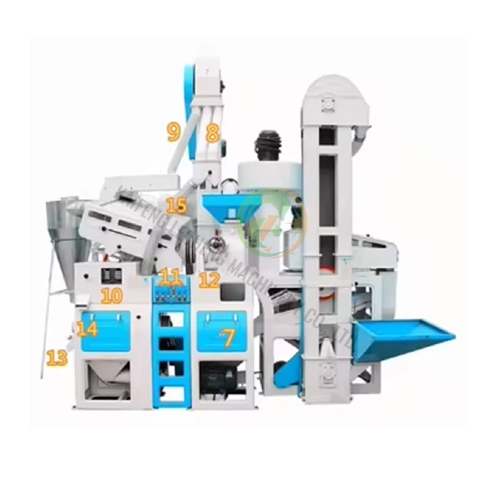
What each machine contributes to the final result
The cleaning section
The cleaner and destoner form the foundation of the whole rice milling process. They remove materials that would otherwise cause damage, unstable feeding, or contamination. Good cleaning improves the working condition of the full line and makes later processing easier to control.
The milling section
The huller, separator, whitener, and polisher should be seen as one connected section rather than separate machines. Their shared purpose is to convert paddy into white rice with as little unnecessary loss as possible. When these machines are well matched, the line works more smoothly and the final quality is easier to maintain. This is one reason why many users prefer combined systems rather than loosely connected standalone units.
The finishing section
Graders, sorters, and packing equipment are where processing quality becomes commercial value. This part of the line determines how neat, uniform, and saleable the final rice looks. For businesses serving wholesalers, retailers, or export customers, consistency at this stage is especially important.
Where rice quality is won or lost
Common causes of broken rice and unstable output
Broken rice usually results from a chain of small problems rather than one single fault. Uneven feeding, incomplete separation, excessive whitening pressure, or inconsistent raw paddy condition can all reduce quality. If operators only focus on the final appearance of the rice, they may overlook the earlier causes of loss. Better results usually come from keeping the entire process stable from the beginning.
How modern rice milling reduces avoidable losses
The value of modern rice milling lies in better process control. Cleaner raw material, more accurate husking, effective separation, and stable whitening all help reduce rework and unnecessary breakage. For growing businesses, this means more predictable production and a better chance of maintaining rice quality from batch to batch. That is exactly why integrated rice milling equipment is widely used in practical commercial operations.
When an integrated rice mill setup makes sense
Why combined systems suit small and medium commercial operations
Not every processor needs a large rice plant. Many farms, cooperatives, and local rice businesses need compact equipment that is easier to install, operate, and maintain. A combined system fits that need well because it brings the key stages together in one working flow. This saves floor space, simplifies management, and helps smaller operations improve product quality without creating an overly complex process.
How one-pass processing simplifies day-to-day operation
One-pass processing makes daily work more efficient because the key stages are linked in a coordinated way. It can reduce transfer points, improve workflow, and make it easier for operators to monitor output. For businesses that want stable performance without unnecessary complexity, this kind of setup is a practical step forward. It also makes the rice milling machine more useful as a complete production tool rather than just a single-function unit.
Conclusion
The steps in modern rice milling work best when they are treated as one connected process rather than separate actions. Cleaning, destoning, husking, separation, whitening, grading, and packing all influence the final rice quality, and better control at each stage leads to better consistency and stronger commercial results. For processors looking for a compact and practical solution, a High-Precision Combined Rice Mill Machine can support efficient paddy-to-rice processing in real production conditions. Kaifeng Lecheng Machinery Co., Ltd. supplies grain processing equipment for customers who want reliable performance and long-term value. Contact us to learn more about the right rice milling solution for your operation.
FAQ
What is the first step in modern rice milling?
The first step is pre-cleaning. Raw paddy usually contains dust, straw, and other unwanted materials that should be removed before the grain enters the milling section. Many lines also include destoning immediately afterward.
Why is paddy separation necessary after husking?
Not all grains are husked completely in one pass. Paddy separation removes the unhusked portion from brown rice and sends it back for reprocessing, which improves efficiency and helps protect grain quality.
Is whitening the final step in the rice milling process?
No. Whitening is an important stage, but rice still needs grading, sorting, and packing after whitening. These final stages improve consistency and help create a market-ready product.
When is a combined rice mill machine a good choice?
A combined rice mill machine is a good option for farms, cooperatives, and small to medium commercial operations that want a compact setup, easier daily operation, and more stable rice processing results.


