Building a commercial seed processing facility requires balancing agricultural science, structural engineering, and strict financial modeling. You cannot treat seed processing like basic grain handling. Seeds are living organisms. Every drop, impact, and poorly calibrated machine degrades their viability. We see this commercial reality frequently. Subpar processing leads to compromised seed germination rates, costly product rejections, and severe operational bottlenecks.
If you fail to size equipment correctly, your entire operation will suffer from mismatched throughput. You might end up bottlenecked at the gravity separator while your primary cleaner idles. We wrote this guide to solve these exact problems. We will provide investors and operations managers with an evidence-based roadmap. You will learn how to design, equip, and scale a profitable seed processing facility. This guide outlines everything from civil engineering requirements to the mathematics of capacity modeling.
Key Takeaways
- Capacity anchoring: Base the entire plant’s throughput on the primary screen cleaner; upstream elevators and downstream graders must mathematically align to prevent bottlenecks.
- Structural integrity matters: Machinery vibration, multistory floor loads, and dynamic silo pressures require specialized civil engineering beyond standard warehousing.
- Calculate realistic throughput: Nameplate capacities are typically benchmarked on wheat; processing lighter or highly variable crops (like paddy or specific vegetable seeds) dramatically reduces actual output.
- Automation is compliance: Modern facilities rely on centralized SCADA systems not just for labor reduction, but to guarantee complete seed traceability.
Pre-Construction: Capacity Modeling and Feasibility Assessment
Before you pour concrete, you must calculate precise capacity models. You need to establish baseline metrics based on seasonal volume requirements. Mid-to-large commercial operations often standardize around 800 to 1,000 bushels per hour. However, this target depends heavily on your crop type and packaging formats. You must decide early if you will dispatch seeds in bulk or via bagged units, as this dictates your entire downstream layout.
You must also understand the "Benchmark" rule for capacity. Equipment manufacturers typically rate their machinery capacity based on dense, free-flowing grains like wheat. If you plan to build a dedicated wheat seed processing plant, these nameplate ratings might be accurate. However, processing lighter or irregular materials requires major adjustments. For instance, processing paddy rice or specialized crops may only achieve 50% of the stated "wheat capacity."
| Crop Type | Density/Flowability | Expected Throughput vs. Nameplate Capacity |
| Wheat / Corn | High / Free-flowing | 100% (Baseline) |
| Soybeans / Peas | High / Free-flowing | 90% - 100% |
| Paddy Rice | Medium / Abrasive | 50% - 60% |
| Grasses / Vegetable Seeds | Low / Irregular | 30% - 40% |
Next, you must apply efficiency adjustments to your models. Never build financial projections assuming machines will run at 100% capacity continuously. We strongly advise modeling financial projections on an 80% operational efficiency rate. This 20% buffer accounts for shift changes, machine calibration, and rigorous cleaning protocols between different seed batches. Planning a flexible seed processing plant for multi-crop use demands more downtime for cleaning than a specialized, single-crop beans processing plant. Always map these realities into your initial feasibility report.
Designing the Core Seed Processing Line
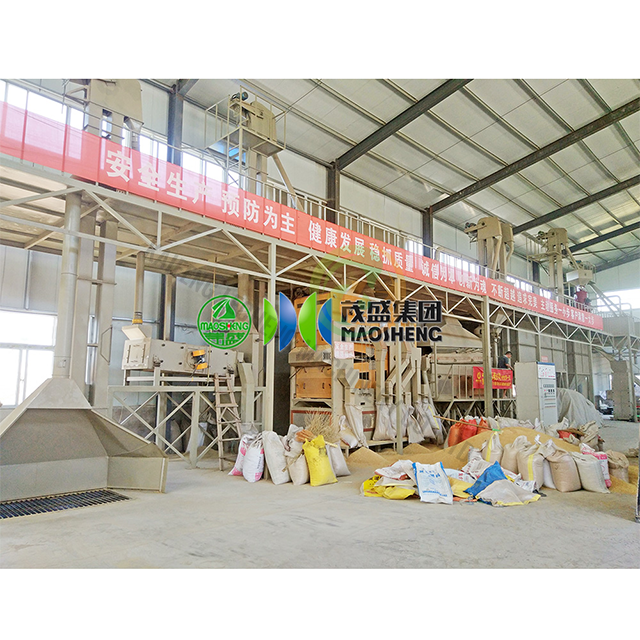
A well-engineered facility follows the irreversible flow principle. Seeds should move through the system logically without backtracking. Backtracking increases physical damage and wastes energy. A standard commercial process follows a strict 7-step sequence:
- Intake: Receiving raw crop from the field.
- Bulk Storage: Holding raw seeds in aerated silos before processing.
- Pre-cleaning: Removing gross impurities like chaff, straw, and dust.
- Primary Cleaning: Using air-screen combinations to remove undersized or oversized debris.
- Separation & Grading: Sorting by length, width, and specific weight.
- Treating & Coating: Applying protective fungicides or germination enhancers.
- Weighing & Packaging: Final bagging and palletizing for shipment.
To execute these steps, you need a highly integrated equipment matrix. Pre-cleaners and aspirators handle the initial gross impurities. Then, the product moves to screen cleaners. The screen cleaner serves as the absolute anchor of any seed cleaning plant. Its throughput dictates the sizing of every bucket elevator upstream and downstream.
For fine grading, indented cylinder separators grade seeds by length to remove short or broken kernels. Gravity separators take over next. They sort seeds by specific weight to remove sterile, insect-damaged, or immature seeds. You must note that gravity separators require perfectly stable 3-phase power to function correctly; voltage fluctuations will destroy their sorting accuracy. Finally, optical sorters utilize AI-driven cameras to perform advanced color and defect removal.
When designing the overall seed processing line, you must engineer "bypass" routes. Sometimes you receive a highly pure batch of seeds. If this batch does not require gravity separation or length grading, the system should allow direct routing to the packaging phase. Bypass chutes save significant energy, reduce wear on sensitive machines, and minimize unnecessary mechanical impacts on the seeds.
Plant Layout Topologies and Structural Engineering
You cannot place heavy processing machinery inside a standard warehouse without risking structural failure. You must evaluate specific building layouts before breaking ground. Each topology offers distinct advantages and challenges.
- Multi-Story Plants: These facilities build upward. They utilize gravity flow heavily. This reduces the number of bucket elevators required, which in turn lowers seed damage risk. However, multi-story plants increase upfront heavy-duty structural steel costs and complicate maintenance access.
- Single-Story Plants: These are easier to construct and monitor. You often need only one operator per shift to oversee the entire floor. But this layout demands extensive use of slow-speed, low-damage bucket elevators to connect horizontal processes, driving up equipment costs.
- Hybrid Layouts: Many modern facilities compromise. They place the primary screen cleaner on a reinforced mezzanine. The rest of the sorting machinery stays on a single, lower plane. This balances equipment costs with structural expenses.
Beyond the layout, civil engineering realities often surprise new investors. Machinery vibration is a critical issue. You must calculate dynamic floor loads for heavy vibrating machinery, especially destoners and gravity tables. If you place a vibrating machine on an inadequate mezzanine, the resonance will damage the building and disrupt the machine’s calibration. Additionally, engineers must design custom floor penetrations for spouting. Finally, you must pour independent structural foundations for bulk storage silos to handle intense point-loading pressures.
Advanced Treatments, Automation, and Seed Traceability
Modern agriculture demands more than just clean seeds. High-value seed treatments now define market competitiveness. You should move beyond basic chemical spraying. Discuss integrating modular units for film coating, pelleting, and priming with your engineering team. These processes are especially crucial for high-margin vegetable or hybrid seeds. Pelleting improves plantability, while priming boosts germination speed. Both treatments protect seeds against soil-borne diseases effectively.
To manage these complex processes, facilities rely on data-driven automation. Standalone machines are obsolete. Modern facilities utilize programmable logic controllers (PLCs) and centralized SCADA software. These systems manage machine integration seamlessly. They capture lot data, monitor extraction rates in real time, and automatically adjust fan speeds if the ambient humidity changes.
Automation directly supports strict traceability requirements. Automated data logging is no longer optional. It serves as a strict compliance requirement in modern agricultural markets. Buyers demand complete "field-to-bag" seed traceability. If a specific seed lot fails in the field, your central database must identify the exact processing date, chemical batch used, and raw material source instantly.
CAPEX, OPEX, and Setup Cost Considerations
Financial modeling dictates plant survival. You must rigorously separate your capital expenditures (CAPEX) from your operational expenditures (OPEX) to maintain healthy cash flow.
CAPEX includes everything required to launch the facility. You must break down costs into land acquisition, civil works, machinery acquisition, electrical infrastructure, and installation. Electrical infrastructure often costs more than anticipated because large processing plants demand heavy-duty panels, specialized transformers, and extensive motor control centers.
OPEX covers the day-to-day realities of running the plant. Do not underestimate hidden costs. You must budget for seasonal labor, packaging consumables, chemical treatments, and substantial power consumption.
The Spare Parts Rule
Downtime during peak harvest season destroys profitability. We advise implementing the 5% spare parts rule. You should set aside a budget equal to roughly 5% of your total equipment cost specifically for high-wear replacement parts. Keep screens, elevator cups, and drive belts in stock over the first three years. This buffer prevents disastrous seasonal downtime when supply chains delay component shipping.
ROI Ramp-Up Expectations
Set realistic financial expectations. A brand-new facility will not hit maximum efficiency on day one. Financial models should account for a gradual capacity utilization ramp-up. We typically project 70% capacity utilization in Year 1. Operators need time to refine the supply chain and train personnel. By Year 3, as the operator dials in the machinery and secures steady raw seed contracts, you can expect utilization to reach 80% to 90%.
Why Procurement Often Shifts Toward a Turnkey Seed Plant
Building a plant piece-by-piece creates massive integration risks. Many investors try to save money by purchasing an aspirator from one vendor, an elevator from another, and a gravity table from a third. This multi-vendor integration often leads to disasters. You will likely face mismatched elevator speeds, incompatible software protocols, and spouting alignment failures. When the plant inevitably bottlenecks, vendors point fingers at each other.
Partnering with a turnkey seed plant provider eliminates this friction. Turnkey providers offer a single source of accountability. They ensure that capacity matching, floor layout generation, and control systems are engineered as one cohesive unit from day one.
Use a strict vendor evaluation checklist before signing contracts. Recommend shortlisting partners based on their ability to provide the following:
- Detailed 3D facility layouts showing actual floor penetrations and maintenance clearances.
- Verified, crop-specific performance guarantees rather than generic wheat-based benchmarks.
- Comprehensive post-installation support, including local PLC troubleshooting and spare parts availability.
Conclusion
A successful commercial seed facility does not happen by accident. It requires meticulous planning. You must marry rigorous capacity mathematics with robust structural and civil design. Do not rely on nameplate capacities without adjusting for your specific crop density, and never ignore the dynamic loads vibrating machines place on your building. Secure stable 3-phase power, enforce strict automation for traceability, and budget wisely for critical spare parts.
If you plan to scale operations, take the next logical step before purchasing equipment. We strongly encourage stakeholders to commission a Detailed Project Report (DPR) or a conceptual engineering study. Analyze your land, define your crop matrix, and establish a firm capacity baseline before breaking ground or issuing equipment RFPs.
FAQ
Q: What is the most critical machine in a seed processing line?
A: The primary air-screen cleaner is the most critical machine. It acts as the absolute capacity anchor for the entire plant. You must size all upstream bucket elevators and downstream grading equipment to mathematically match the throughput of this primary cleaner to prevent bottlenecks.
Q: Can a single plant process multiple types of crops?
A: Yes, a single plant can process multiple crops. However, it requires an extensive inventory of interchangeable screens and variable speed drives for elevators. You must also implement strict, labor-intensive clean-down protocols between crop runs to completely prevent seed cross-contamination.
Q: What are the power requirements for a commercial seed plant?
A: A commercial facility absolutely requires stable, industrial 3-phase power. Sensitive grading equipment, particularly gravity separators and AI-driven optical sorters, will fail to operate accurately if voltage fluctuates. You may also need dedicated backup generators to protect PLC data during outages.
Q: How long does it take to build a commercial seed facility?
A: A commercial facility typically takes 8 to 14 months to complete. This timeline covers initial feasibility planning, structural engineering, custom equipment lead times (often 4 to 6 months), physical installation, and a mandatory multi-week commissioning phase to calibrate machines with actual seed.


